Skip to content





Contractors ask our team some version of the same question: we did everything on the list, so why is the company down the road still above us?
The honest answer was uncomfortable. The list had been written for an average market, and nobody competes in the average market. Our own client pages showed it. In two markets we studied, they ran two to three times longer than the pages beating them, and they named more towns.
I should say where I stand. I am COO of RS Gonzales, a US agency that sells search work to home-services contractors, and founder of Soltiks. The method below is how we now work at RS Gonzales, and I have given it a name: Rulesourcing.
Rulesourcing, defined
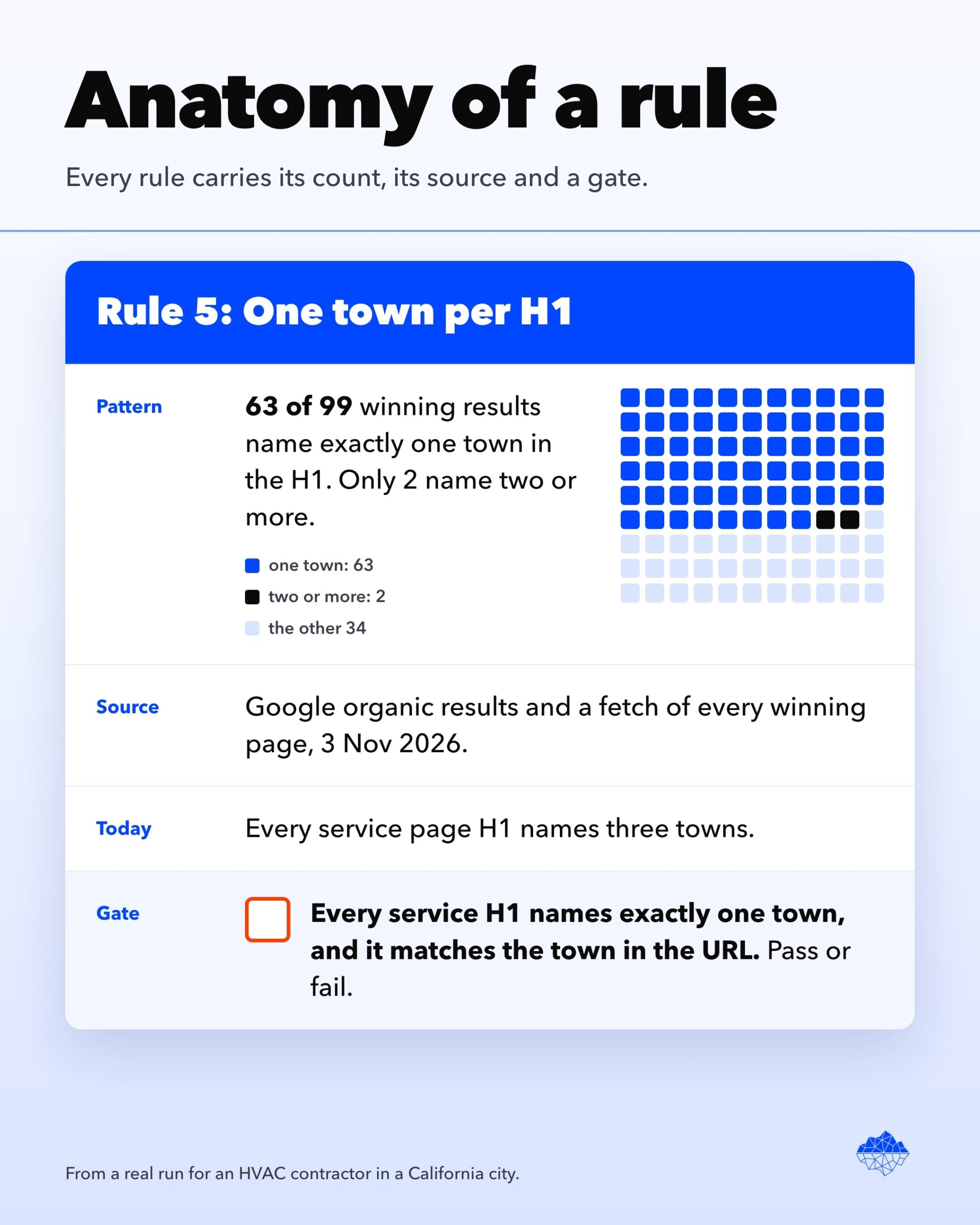
Rulesourcing (n.): deriving a business’s search, advertising or AI-visibility rules from the businesses already winning in its own target market, instead of from universal checklists. Each rule carries the count it rests on, its source and a pass/fail gate, and the market is re-measured every month.
The checklist asks what works in general. The new question is what the winners in this client’s market share, how many of them share it, and what none of them do.
How the work is split
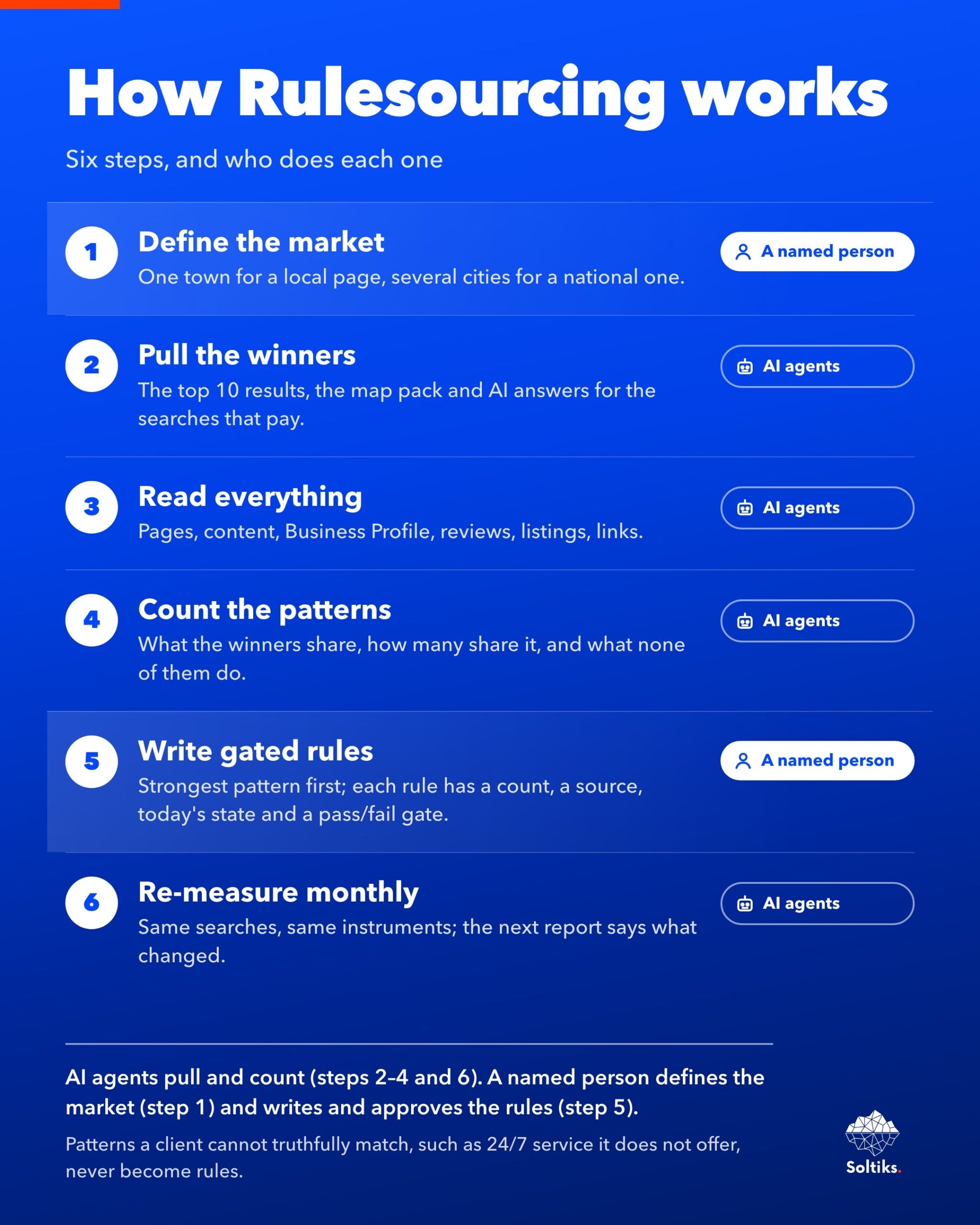
The method has six steps. Define the market, pull the winners, read everything about them, count the patterns, write gated rules, and re-measure monthly.
AI agents do the counting. They pull the top 10 results, the map pack and the AI answers, fetch every winning page, and tally what the winners have in common. That is the part no agency team has time to do by hand for every client.
A named person decides. Someone defines the market, reads the counts and signs off each rule. At RS Gonzales, the people who run this are permanent, full-time members of the RS Gonzales team, employed through Soltiks.
Two markets, opposite rules
In a suburban Pennsylvania market, contractor homepages held 36 of the 70 places in Google’s top 10 for heating and air searches. The rule was to put the town in the homepage title, because the homepage is what wins there.
In Central Florida, searches about slime clogging AC drain lines went another way. Contractors were 3 of the 56 places; videos and forum threads were 22. A YouTube video sat in the top 10 for all six searches. The rule was to film a technician clearing a real drain, with the customer’s permission.
A checklist would have given both clients the same advice. One of them would have spent a season on the wrong work.
Local or national is a measurement
General patterns are not ruled out. They appear when the market is wide.
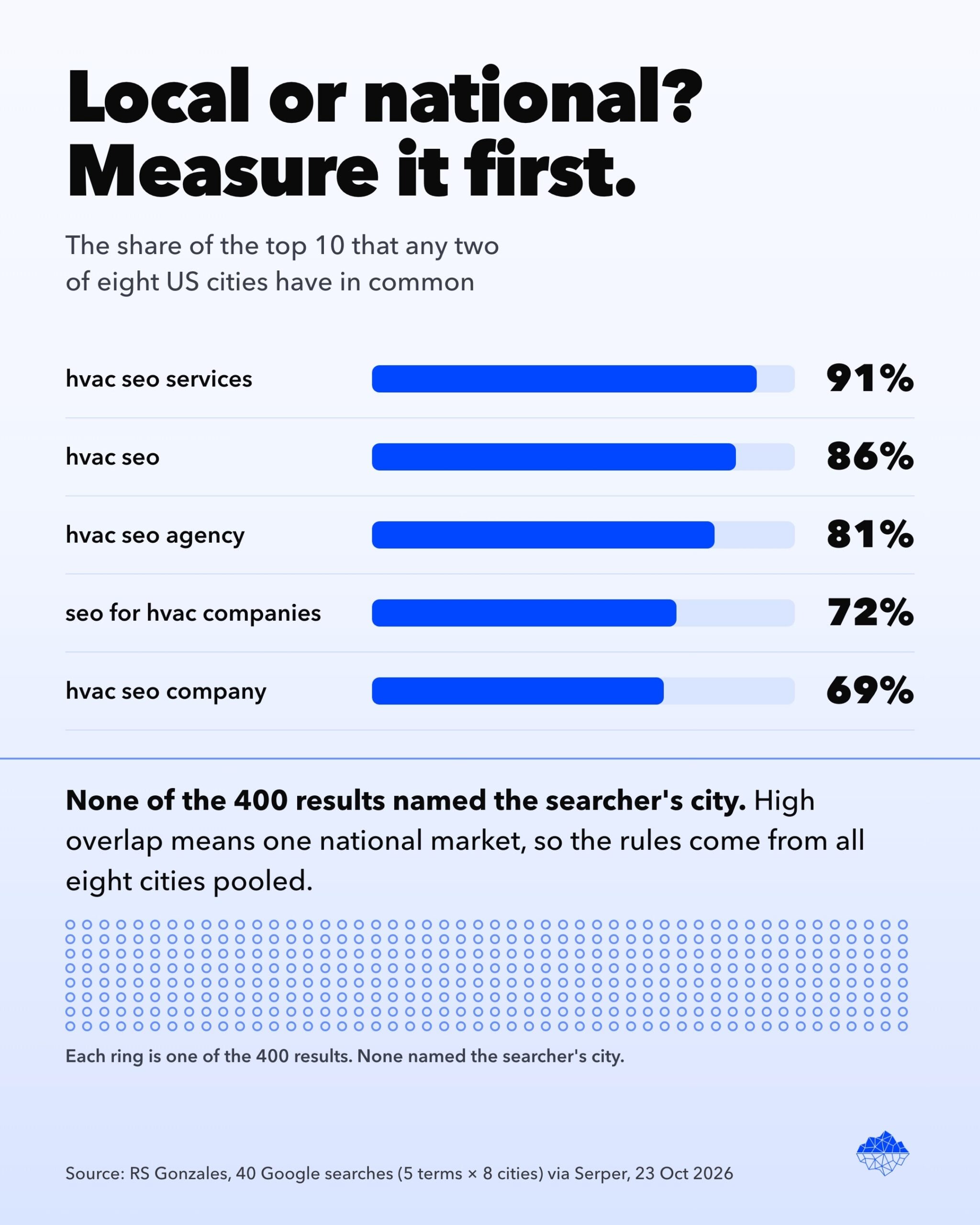
For our own page aimed at agencies searching “hvac seo agency”, we ran five national searches from eight US cities. Any two cities shared 69% to 91% of the same top 10, and none of the 400 results named the searcher’s city. That is one national market, so those rules came from all eight cities pooled. A town page takes its rules from its own town.
What it will not copy
Claims the client cannot keep. In one market, 26 of 34 winning pages promised 24/7 service. Our client is not open around the clock, so its rule says the real hours and the after-hours callback instead.
Myths the data does not support. In another market, winning pages were a median 886 words long; the client’s were 2,906. No rule asks for more words.
Gaps nobody has filled. Google showed the same cost question on 10 of the 11 searches that carried questions, and none of 34 competitor pages answered it. That gap is now a rule, answered with the client’s confirmed prices.
What this changes for an agency
The deliverable changes. The client gets rules with counts and sources, and a monthly report that says what moved. It is easier to defend than “best practice”, because every rule shows its evidence.
The work scales differently. A checklist scales by copying. Rulesourcing scales because agents do the counting, so a person’s time goes into judgment: which market, which rule, and when to say no.
The same method reaches further. For Local Services Ads, Google names the factors it weighs but not how much each one counts. The leaders can still be observed. For paid search, the patterns have to come from an agency’s own accounts, because competitors’ costs are not public.
The honest limits
Patterns are not proof of cause. A rule records what the winners share, not why Google rewards it, which is why every rule carries a gate and every market is measured again.
We have not published a result yet. Between 2 and 6 November we rebuilt our own national page and twelve city pages to rulesourced rules. Fourteen more are next, and until then they are the comparison. The checkpoints are 30 November, 28 December and 25 January, and we will publish what we find.
The short version
Stop asking what works in general. Ask what the winners in your client’s market share, count it, and turn it into rules you can test.
If you want your team to work this way, talk to us at Soltiks.