


By Mo. Abubakar Lala, Founder and CEO, Soltiks
Clients have started asking their agencies a new question: can you get us recommended by ChatGPT? Most agencies answer with a menu. Add schema. Publish an llms.txt file. Get into more directories. Run more ads. Each item sounds reasonable, and each one can be billed.
I wanted to know which of those things actually separate the firms AI assistants recommend from the firms they ignore. So I tested an idea of my own against public data, and half of it was wrong.
A word on where I stand first. I run Soltiks, which builds AI-agent systems and dedicated teams for marketing agencies. I am also chief operating officer of RS Gonzales, a US agency that sells local search and AI-visibility work to HVAC contractors. So I have a stake in the answer. That is one reason the full study, with its method and every number, is public.
The idea I tested
I called it Everything Affects Everything, the EAE principle. A business is read as one record: its Google profile, its reviews, its website, its listings, its posts. People read it that way, and so do the AI systems that now answer “who should I call?”
The strong version made two claims: every channel raises the value of the others, and your weakest channel caps everything else.
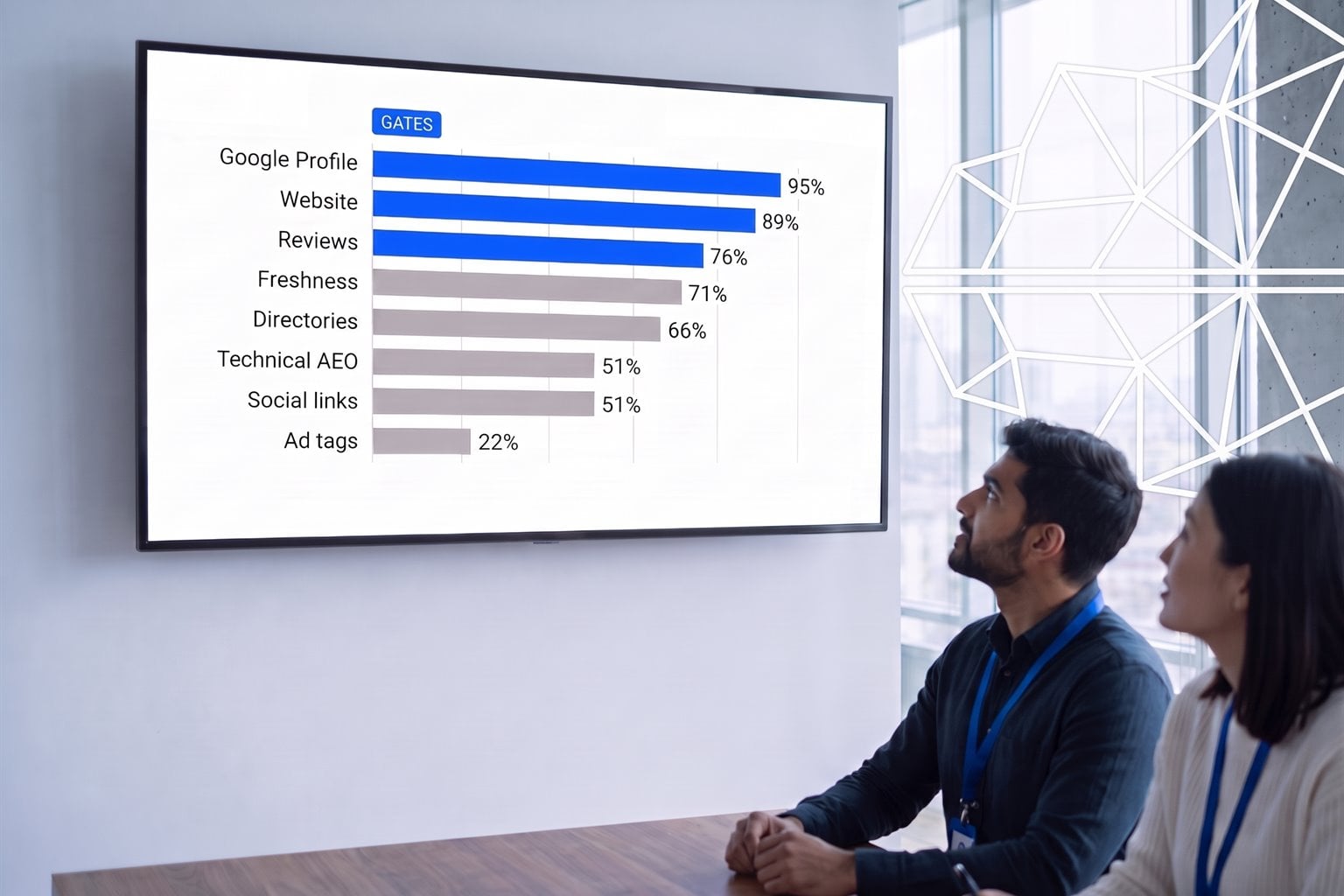
I scored eight public channels for 835 HVAC contractors in ten US metro areas, from data anyone can see. Then I checked which of those firms four AI assistants recommended when asked the questions homeowners ask. Of those 835, 704 were fully measured, and the channel chart below uses that group.
What failed
The strong version did not survive. The weakest-link model was the worst fit to the data, and an additive model was the best. Not one pair of channels showed significant synergy. Most pairs leaned the other way, with two strong channels counting for less together than their two effects added up. Channels did not multiply each other, and a firm’s weakest channel was not what decided its fate.
What survived
Two narrower claims held up, and they are more useful than the original.
Some channels are gates. The Google Business Profile and the reviews were necessary under every way I treated missing data. A basic, working website was a third gate in most analyses. Of the 72 fully measured firms the assistants named ten or more times, not one was weak in a gate. For most firms that had a website, the gate holding them back was reviews. So a weak channel does cap a firm, but only when it is one of these three.
Past the gates, breadth adds up. Among firms that passed all three gates, 28% of those with no other strong channel were recommended. Among those strong in all five other channels, 64% were. More strong channels meant more recommendations, and the pattern was accumulation, not synergy.
And some things made no clear difference in separating the firms the assistants named: ad-tracking tags, directory listings found by searching the firm’s name, and technical items such as llms.txt files. The ad and listing measures are rough proxies, so I would not call them worthless. But they are weak grounds for promising a client AI visibility.

What this means for an agency
Here is the part that matters if you sell this work.
Start every AI-visibility audit with a gate report. Profile, reviews, website: pass or fail, before anything else. If a client fails a gate, nothing further down the menu is likely to help much yet.
Sell a sequence, not a menu. Gates first, then breadth. A client with thin reviews does not need an llms.txt file this month; what they need is a steady flow of honest reviews and someone who answers them.
Stop promising AI rankings from quick technical fixes. In this data, the easy items were not what separated the winners. If your proposal leads with them, you are selling the part that is easiest to deliver, not the part that works.
Report two numbers every month. The first is gate status, and the second is the count of strong channels. Both come from public data, and both are easy to explain to an owner who has no time.
Measure the outcome properly. AI answers are not stable from one run to the next. Ask the same questions of several assistants, more than once, at regular intervals. One screenshot of one answer proves nothing.

Where AI agents fit
None of this is genius work. It is a routine, and the risk is that it gets skipped.
Checking gates and counting strong channels across every client, every month, is the kind of job agents are good at. The data is public. The scoring is rules. The record is a spreadsheet. What agents should not do is decide what to tell the client. A named person reads the report, judges what matters for that business, and signs off.
That is how we build these systems at Soltiks. Agents gather and score; a person decides. Where data is missing, the agent leaves a blank rather than guessing.
The honest limits
This is one trade, in ten metros, measured on one day. The data is a single snapshot, so it shows what the recommended firms had in common, not what caused their recommendations. The narrower version of the idea came from the same data that rejected the strong one, so it still needs testing in other markets. The gates might also partly reflect what machines find easiest to read. But a gate a machine reads is still a gate, and your client still has to pass it.
The short version
Everything is read together. Only a few things are required. Secure the gates, then widen.
If your agency wants to build a gate audit into its delivery, with agents doing the checking and your people doing the judging, talk to us at Soltiks.
The preprint: Lala, M. A. (2026). Everything Affects Everything: Core Gates and Cumulative Breadth in the AI Visibility of HVAC Contractors. SSRN. doi.org/10.2139/ssrn.7598898. The paper is under peer review.